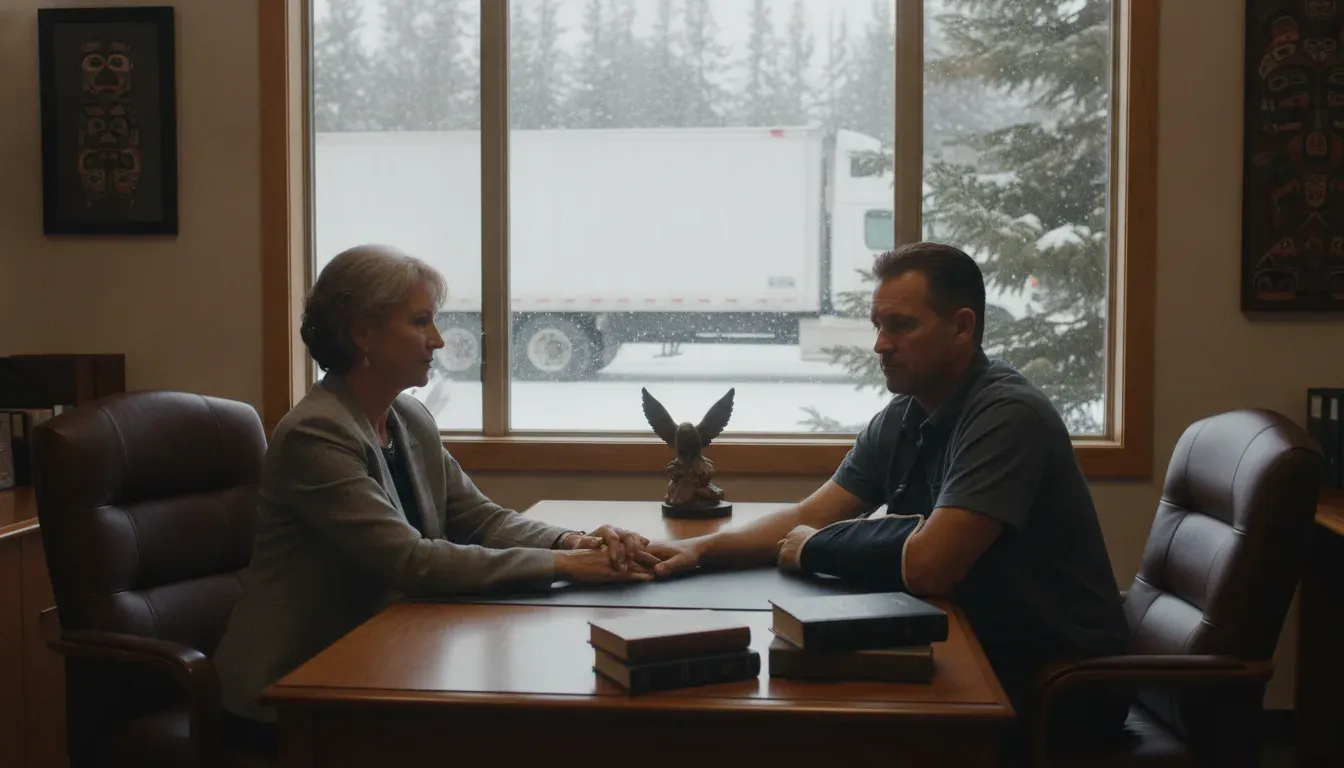
An 18-wheeler crash can leave an injured person facing severe medical needs while a trucking company and its insurers begin examining what happened. Important evidence may include driver records, vehicle maintenance history, cargo information, and the circumstances surrounding the collision. Understanding how accountability is evaluated early can help you protect your options.
Request a free consultation or call 907-569-6633. The Law Office of Jason Skala, LLC offers a free consultation with no upfront fees.
An 18 wheeler accident attorney anchorage alaska victims can consult will examine potential responsibility beyond the driver, including the trucking company, maintenance providers, manufacturers, and cargo loaders. The goal is to identify what the evidence supports, not assume liability before the facts are investigated.
For broader guidance, see Anchorage car and truck accident legal claims. The seriousness of these crashes starts with the size and operation of the vehicles involved, and those factors shape how an injury claim should be evaluated.
What Makes 18-Wheeler Crashes So Serious in Alaska?
An 18-wheeler can create forces that are very different from those involved in an ordinary passenger-vehicle collision. Large commercial trucks may weigh up to 80,000 pounds. Their size, weight, momentum, and longer stopping distance can make a crash especially destructive, particularly when a smaller vehicle is struck or pushed into another hazard.
The severity of a particular crash depends on the vehicles, speeds, road conditions, point of impact, and injuries involved. It is not accurate to assign every Alaska truck crash a statistic or predictable outcome without reliable case-specific evidence. What can be examined is how the collision happened and whether a preventable safety problem contributed to it.
Fatigue and hours-of-service violations
Fatigue can affect alertness, reaction time, and judgment. A review may examine whether the driver had adequate rest, whether dispatch demands encouraged unsafe scheduling, and whether required driving or duty limits were followed. A possible hours-of-service violation does not automatically prove legal liability, but it may be important evidence when it aligns with the driver’s condition, records, and crash sequence.
Training, maintenance, and equipment problems
Commercial carriers are expected to use qualified drivers and keep their vehicles in safe operating condition. Poor training may leave a driver unprepared to manage a heavy load, difficult maneuver, or changing road conditions. Maintenance failures, such as neglected brakes or tires, can reduce a truck’s ability to stop or stay under control. A defective part may raise separate questions about the equipment involved.
Cargo loading and shifting weight
Improperly loaded or secured cargo can shift the truck’s balance, increase instability, or create a hazard during a turn or sudden stop. Investigators may therefore look beyond the driver and ask who selected, loaded, secured, inspected, and managed the cargo. These facts help distinguish a tragic accident from a crash involving a potentially preventable safety failure.
Who May Be Liable When a Semi-Truck Causes a Crash?
Liability in an 18-wheeler collision is not always limited to the person behind the wheel. The facts may point to one responsible party, several parties, or different legal theories that must be evaluated separately. An investigation should identify what happened before anyone concludes who is legally liable.
The truck driver and trucking company
The driver may be responsible if careless driving, distraction, impairment, fatigue, inadequate attention, or another unsafe decision contributed to the crash. The driver’s conduct and training history may also raise questions about whether the carrier hired and supervised the driver appropriately.
The trucking company, sometimes called the carrier, may face direct claims based on its own conduct. Investigators may examine hiring, training, supervision, scheduling, dispatch pressure, and whether the company maintained safe operating practices. In some cases, the company may also be legally responsible for an employee’s work-related conduct. That conclusion depends on the employment relationship and the evidence, not simply on the fact that the truck displayed the company’s name.
Maintenance providers and manufacturers
A maintenance provider may become relevant when a brake failure, tire blowout, steering problem, or other mechanical issue is connected to inspection or repair work. The vehicle owner or carrier’s maintenance records may help show who was responsible for identifying and correcting a dangerous condition.
A manufacturer may be considered when a defective part or design problem contributed to the collision. Establishing that theory generally requires examining the failed component, the truck’s maintenance history, and whether the condition existed when the part left the manufacturer. A damaged or discarded part can make that investigation more difficult.
Cargo loaders and other responsible parties
The party that loaded or secured cargo may be examined when shifting, overweight, or improperly balanced freight affected the truck’s handling. Cargo records, loading procedures, photographs, and inspection evidence can help connect the condition of the load to the crash.
These overlapping possibilities are why preserving evidence matters. A truck wreck law firm guide can provide general background, but a case-specific review is needed to distinguish a possible theory from proof that supports a claim.
What Evidence Matters After an Anchorage Truck Crash?
Evidence can show what happened before impact, who controlled the truck, and how the crash affected you. Preserve what you can without putting yourself at risk, and avoid assuming that one record will answer every liability question.
Driver hours and electronic records
Hours-of-service records may help investigators assess whether fatigue or scheduling played a role. The Federal Motor Carrier Safety Administration publishes standard property-carrier rules. A driver may drive up to 11 hours after 10 consecutive hours off duty and may not drive beyond the 14th consecutive hour after coming on duty. The rules also call for a 30-minute break after eight cumulative driving hours without a qualifying interruption. These rules can have exceptions and fact-specific applications, so the records must be evaluated in context. FMCSA’s hours-of-service summary provides the governing details.
An electronic logging device, or ELD, can preserve more than a driver’s handwritten account. FMCSA guidance states that an ELD records the actual time for each duty status entered or automatically started. If a driver has not logged in while the vehicle is moving, accumulated driving and on-duty, non-driving time may be recorded under an unidentified-driver profile. The device also automatically switches to driving status once the vehicle is moving at no more than five miles per hour. Those entries and any later annotations may be important for reconstructing the trip. See FMCSA’s ELD guidance.
Vehicle, cargo, and scene evidence
Other potentially important evidence includes the truck’s event data, inspection and maintenance records, repair history, and records concerning tires, brakes, or other components. Cargo-loading documents and photographs may help show whether the load was secured and whether shifting cargo contributed to the crash. Keep your own photographs of the scene, vehicles, road conditions, visible injuries, and property damage when practical. Witness names and contact information can preserve accounts that may otherwise become difficult to locate.
Medical records, diagnostic studies, treatment instructions, and a record of symptoms help connect the collision to the injuries being evaluated. Preserve insurer communications and do not discard damaged vehicle or safety equipment before receiving guidance. A focused truck accident claim investigation can help identify which records to request and preserve before they are altered or lost.
How Do Commercial Truck Insurance Claims Differ?
A commercial truck crash can involve more than one insurance policy and more than one organization. The truck driver may have personal responsibilities, while the carrier, vehicle owner, leasing company, maintenance provider, or cargo-related business may have separate roles. Determining which entities and policies are connected to the collision requires reviewing ownership, employment, operating, maintenance, and loading relationships. Do not assume the first company identified is the only responsible party.
| Question to investigate | Why it matters |
|---|---|
| Who owned or leased the truck? | Ownership and leasing records can identify which businesses had control or responsibility for the vehicle. |
| Who employed or dispatched the driver? | Employment and dispatch records may clarify the carrier’s role and the driver’s work-related activity. |
| Who maintained and inspected the truck? | Repair and inspection records can help evaluate whether a mechanical condition was identified or overlooked. |
| Who arranged, loaded, or secured the cargo? | Loading records and photographs may show whether freight affected the truck’s balance or handling. |
Commercial coverage questions can also depend on the specific facts of the trip and the people or businesses involved. A claim may require examining whether the driver was working for a carrier. Who controlled the vehicle, who arranged the load, and who was responsible for inspections or repairs. Those questions are separate from deciding whether negligence caused the crash, but they can affect how a claim is investigated and presented.
Early contact from an insurer or a trucking company representative deserves care. You should answer necessary questions honestly, but avoid guessing about how the collision happened or minimizing your injuries. Do not agree that a version of events is complete before the evidence has been reviewed. Keep copies of messages, letters, recorded-statement requests, medical-related questions, and any documents you receive. Do not discard photographs, repair information, or other records that may help explain what occurred.
An attorney can review the available communications and investigate the relationships among the driver, carrier, owner, leasing entities, and other businesses. The goal is not to assume coverage or liability, but to identify the relevant facts and preserve the information needed to evaluate the claim fairly.
What Should You Do After an 18-Wheeler Crash?
The first priority after a serious truck collision is safety and medical attention. The steps you take afterward can also help preserve information needed to understand what happened. Use this as general guidance, not as a substitute for advice about your specific circumstances.
- Get medical care promptly. Call 911 when emergency help is needed, follow the treating provider’s instructions, and keep records of visits, symptoms, medications, and recommended follow-up. Some serious injuries are not immediately obvious.
- Report the crash as appropriate. Cooperate with responding officers and provide accurate facts. If you are able, make sure the incident is documented and obtain information about the report or investigating agency.
- Preserve photographs and contact information. Photograph the vehicles, roadway, traffic controls, visible injuries, and surrounding conditions when it is safe. Save witness names and contact details, along with the truck, driver, and carrier information available to you. Do not return to an unsafe scene just to gather evidence.
- Keep a complete claim file. Save medical records, bills, work information, repair documents, photographs, correspondence, voicemails, and notes about conversations. Preserve messages from insurers and trucking companies rather than deleting or editing them.
- Be careful with insurer communications. Give necessary factual information, but do not guess about fault, minimize your injuries, or provide a recorded statement or broad medical authorization without understanding what you are signing. Commercial truck claims can involve several entities and layers of investigation.
- Request focused legal guidance. An attorney can help identify evidence to preserve and evaluate potential claims without assuming that every crash follows the same rules. Review Anchorage car and truck accident legal claims and the practical guidance on protecting an Anchorage injury claim, then consider a focused consultation about your situation.
How an 18 Wheeler Accident Attorney in Anchorage Alaska Builds a Case
A serious commercial-truck case requires more than collecting a police report and waiting for an insurer’s offer. Counsel may begin by identifying the people and companies involved, sending preservation requests, and determining what evidence could explain how the crash happened. That can include driver records, vehicle data, maintenance and inspection materials, cargo information, photographs, witness accounts, and medical records.
Preserving evidence before it disappears
Trucking evidence may be held by several parties, including the carrier, driver, maintenance providers, and other companies connected to the load. A focused investigation helps identify which records matter and where they may be located. It also helps separate an initial theory from facts that can be tested. The goal is not to assume liability, but to build a reliable account of the collision and its consequences.
Connecting medical evidence to the injury
Serious injuries often involve extensive records, treatment, and long-term questions. Attorney Jason Skala comes from a family lineage of doctors. That background informs his ability to read and understand medical records while evaluating how the crash affected an injured person or family. The Law Office of Jason Skala, LLC focuses exclusively on serious personal injury and wrongful death cases. Rather than treating a truck crash as one matter among many unrelated practice areas.
Jason Skala brings more than 20 years of personal-injury experience and has documented recovery experience for clients. Past results are not a prediction, and the firm’s background does not mean every claim will have the same outcome. It is one part of evaluating the firm’s experience alongside the facts, injuries, evidence, and potential sources of recovery in a particular claim.
If you are trying to understand what happened after a crash, you can request a free consultation or call 907-569-6633. The firm represents clients across Alaska, including people in remote communities, and consultations do not require an upfront fee.
Evaluating the claim realistically
A case assessment should address both strengths and uncertainty. Evidence may support claims against one or more parties, but responsibility must be established from the available facts. The same is true of damages and future needs. A contingency-fee arrangement means attorney fees are taken only upon a successful recovery, so there are no upfront attorney fees. You Don’t Pay. They Do. The consultation is an opportunity to discuss the evidence and next steps without a promise of a particular result.
Frequently Asked Questions
Who may be responsible for an 18-wheeler crash?
Responsibility depends on the evidence. Potentially responsible parties may include the truck driver, trucking company, maintenance provider, manufacturer, or cargo loader. An investigation should examine issues such as fatigue, training, maintenance, defective parts, and cargo loading before anyone is treated as liable.
What happens to electronic logging device records after a truck crash?
Electronic logging devices, or ELDs, record duty-status information and can record driving and on-duty time under an unidentified-driver profile when a driver has not logged in. The Federal Motor Carrier Safety Administration explains that an ELD records the actual time for each duty status entered or automatically started. Preserving these records promptly can help evaluate hours-of-service compliance and possible fatigue evidence. FMCSA ELD guidance
Should I speak with the trucking company’s insurer?
Be careful before giving a recorded statement, signing a release, or discussing the full extent of your injuries. You can provide basic accident information, but it is important to understand what is being requested and how the information may affect your claim. Consider getting advice before making substantive statements or accepting an offer.
How long do I have to bring an Alaska truck-crash injury claim?
Alaska law generally provides a two-year period for an action involving personal injury or death, measured from accrual, unless another law provides otherwise. The correct deadline can depend on the people involved, the claim, and specific facts. So confirm the applicable limitation period with an Alaska attorney rather than relying on this general summary. Alaska Statute 09.10.070
How are attorney fees handled in a truck-crash case?
The Law Office of Jason Skala, LLC uses a contingency-fee model for these serious injury matters. That means there are no upfront attorney fees, and attorney fees are taken only upon a successful recovery. The consultation is free, and the specific agreement should explain the fee arrangement and case expenses before representation begins.
Schedule a Confidential Consultation
After an 18-wheeler crash, a confidential conversation can help you understand the evidence and insurance issues that may affect your claim. The Law Office of Jason Skala, LLC offers free consultations with no upfront fees. You Don’t Pay. They Do. Request a free consultation during Monday-Friday, 9:00 AM-5:00 PM Alaska Time. The firm can discuss your situation and explain possible next steps without promising a particular result.