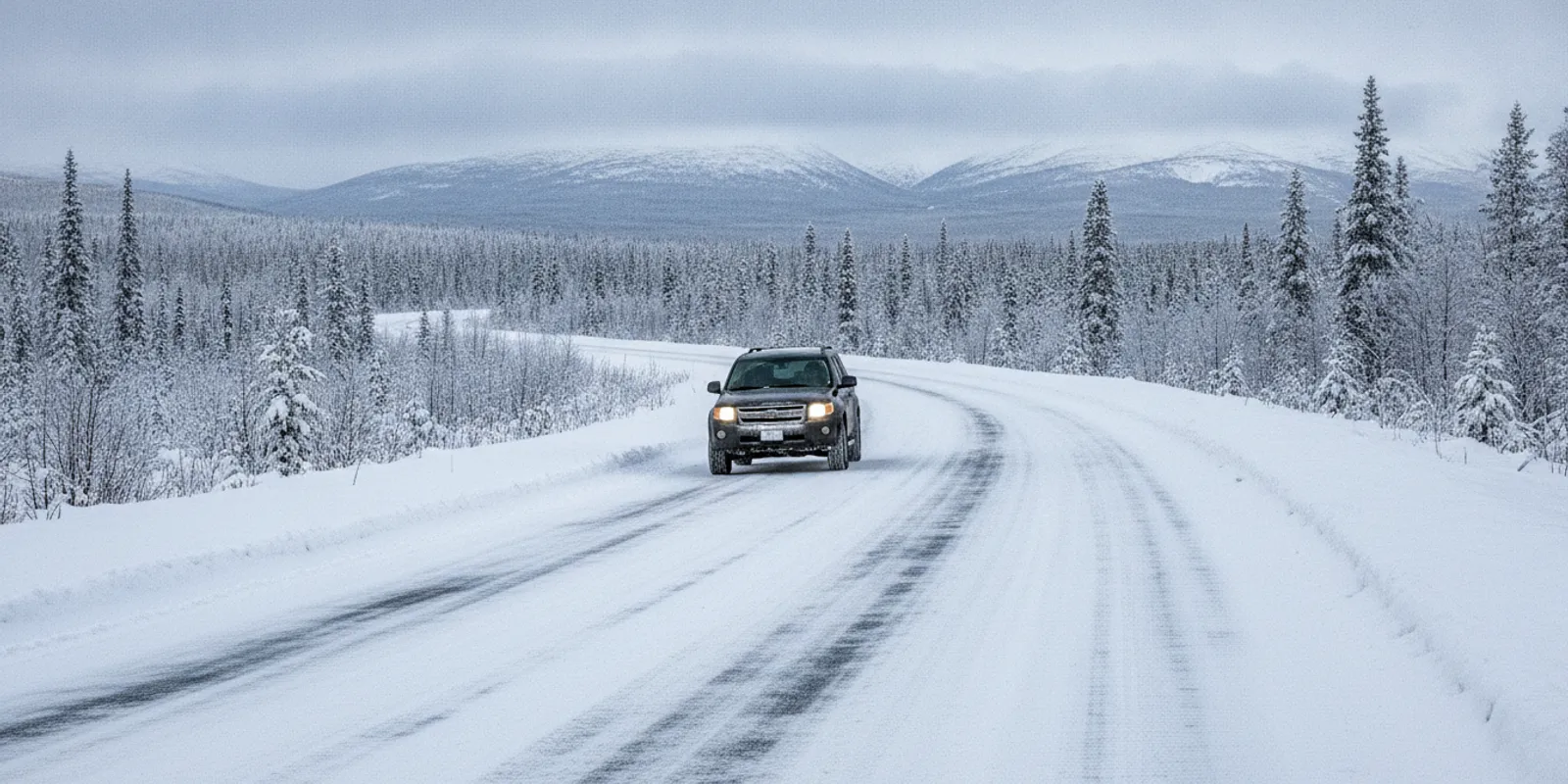
After a crash on an icy Alaska road, it is natural to ask whether the weather or another person is responsible. Alaska winter driving accident liability depends on the full picture: the road and visibility, what each driver did, whether a road hazard was foreseeable, and what evidence can show. Snow or ice may help explain a collision, but it does not automatically decide who is legally at fault.
Schedule a free consultation to discuss your situation; there are no upfront attorney fees, and fees are owed only if the firm wins compensation.
Does winter weather automatically make a driver liable?
No. A winter crash may involve several contributing conditions at once. Ice can reduce traction, blowing snow can limit visibility, and a vehicle may be unable to stop as quickly as it could on dry pavement. Those conditions matter, but they do not replace the question of how people acted in the circumstances.
Drivers are generally expected to use reasonable care. In winter, that can mean slowing down, leaving more room to stop, using appropriate lights, and avoiding a maneuver that is unsafe for the conditions. A driver who loses control on ice is not automatically at fault simply because the vehicle slid. But evidence that the driver was moving too fast for visibility or traction, following too closely, or making an unsafe pass may support a finding of negligence.
Likewise, an icy road does not automatically make a government agency, property owner, or maintenance contractor responsible. A claim against another party usually requires evidence about that party’s duty, what it knew or should have known, what steps were reasonable, and whether a failure contributed to the crash. The precise rules depend on the parties and facts. A general article cannot decide those questions for a particular collision.
How do road conditions and driver conduct fit together?
Investigators and insurers may look at the conditions that existed at the time, not just the weather report for the day. A broad forecast saying “snow” does not establish whether the road where a crash occurred was polished ice, packed snow, slush, or clear pavement. Conditions can change over a short distance and over a short time.
Driver conduct is evaluated against those circumstances. A speed that might be reasonable on a dry road may be unsafe on a slick curve or in low visibility. On the other hand, an unexpected patch of ice can cause a loss of control even when a driver was cautious. The key is to connect specific facts to the collision rather than assume that either the weather or one person’s account settles the issue.
Useful questions can include:
- What were the road surface, lighting, and visibility at the precise location?
- Was the road hazard visible or reasonably predictable before the collision?
- How fast were the vehicles traveling relative to the conditions?
- Did a driver have time and space to brake, steer, or take another safe action?
- Were there warnings, signs, closures, or reports about the hazard?
- Did vehicle condition, tires, lighting, or loading affect the ability to respond?
These questions are fact-specific. A crash report, photographs, witness accounts, vehicle data, and weather or maintenance records may each answer only part of the puzzle. For broader information about the firm’s work with serious collisions, see its car accident practice page.
Can more than one person or condition contribute to a winter crash?
Yes. A collision may involve a driver’s choices, a sudden road hazard, visibility, and road treatment. For example, a driver may have been traveling too quickly for conditions while another vehicle made an unsafe turn. Or a driver may have lost traction where an icy area had not been treated. The fact that one factor contributed does not necessarily eliminate the importance of another.
Alaska applies comparative fault principles. In general terms, a person’s own share of fault can reduce the damages they may recover, and Alaska law limits recovery when the person’s fault is greater than the fault of the party or parties from whom recovery is sought. The details depend on how the claim is framed and which parties are involved. The Alaska Legislature’s public resources provide access to state law; an attorney can help apply the law to the evidence in an individual case.
That is one reason not to treat an early insurance assessment as the final answer. An adjuster may focus on a driver’s speed or a statement made at the scene, while other evidence about the road, visibility, or a second driver’s actions has not yet been gathered. Fault should be assessed using the whole record, not one isolated detail.
How might an insurer evaluate a winter-crash claim?
An insurer may review the collision from several angles: which person or entity may have caused it, what injuries and losses followed, and whether the available records support the account. The initial version of events is not always complete. Conditions may be described differently by drivers who saw the road from different directions, and a photograph taken later may not show what the surface looked like at impact. Keep the distinction between what you personally observed and what you learned from someone else.
When speaking with an insurer, give accurate information and avoid filling gaps in memory with estimates. If you do not know how fast a vehicle was traveling or exactly when you first saw it, say so rather than guessing. A brief, factual account is more useful than speculation about who was legally responsible. Ask what documents are requested, keep copies of what you provide, and read any written statement carefully before signing. If an insurer asks for a recorded statement, you can clarify whose insurer it is and what the request concerns before deciding how to respond.
Evidence can also change as the claim develops. A witness may be located, vehicle damage may clarify the impact sequence, or records may provide more detail about the road conditions. You do not need to resolve every legal question during the first call with an adjuster. Save claim numbers and contact details, note the date and substance of conversations, and promptly correct an important factual error if you discover one.
For a serious injury, a lawyer can help organize evidence and assess whether a proposed fault allocation accounts for all relevant facts. The firm’s case-results archive offers examples of documented outcomes in other matters, but each claim has its own facts and prior results do not predict or guarantee a result in a new case.
Could road maintenance or a dangerous condition matter?
Sometimes. Responsibility may depend on who controlled or maintained the road, the nature of the hazard, how long it existed, whether the responsible party had notice or a reasonable opportunity to address it, and what steps were required under the circumstances. A snow-covered road alone does not prove negligent maintenance. Nor does the fact that a road was treated prove that it was safe at every point and time.
Questions about public roads can involve special rules and deadlines. The government entity, its role, the location, and the type of claim can affect what notice or procedure is required. Do not assume the ordinary process for a claim against another driver applies in the same way to every public-road claim. Promptly preserve relevant information and seek advice if a serious injury may involve a maintenance issue.
Private property can raise different questions. A parking lot, driveway, or access road may be controlled by an owner, business, or other party. The important facts may include who was responsible for clearing or warning about the area, when the dangerous condition arose, and whether the injured person could reasonably see and avoid it. This does not mean every slip, spin, or collision on private property creates a claim.
What evidence can help explain an Alaska winter crash?
Winter conditions can change quickly. If it is safe and practical, record what the scene looks like before snow removal, traffic, or changing light alters it. Do not put yourself in danger to gather evidence, and do not delay medical care to take pictures.
- Photographs and video: Capture the vehicles, their positions, road surface, ice or snow, visibility, signs, skid marks, lighting, and nearby landmarks. Take wide views as well as close-ups.
- Time and location: Write down the exact location and approximate time. Note direction of travel, lane, slope, curve, and any change in road surface.
- Witness information: Ask for names and contact details. A witness may have seen the seconds before impact or may know how the road looked before it was disturbed.
- Official records: Keep the report number and identify which agency responded. Weather observations, road-condition reports, maintenance logs, and relevant public records may help establish conditions, if available.
- Vehicle information: Preserve photographs of damage and note tire condition, lights, and any warning indicators. Do not repair or discard important parts before documenting them when possible.
- Medical records: Seek appropriate medical care and keep discharge instructions, appointment information, and records of symptoms. These can help connect the crash to the injuries and document treatment.
- Communications: Save messages from insurers and others, and make a note of calls. Avoid guessing about speed, distance, or fault when the facts are not clear.
A study examining seasonal relationships between winter weather and reported crashes illustrates why weather and crash conditions can be studied together; it does not establish responsibility in any individual case. The research on weather conditions and crash patterns concerns a separate study context, not an Alaska legal rule. Research on moose-vehicle collisions also discusses how winter snow can affect driver detection and moose movement in Alaska, but that background cannot determine fault after a specific collision. See the academic analysis of factors associated with moose-vehicle collisions.
Keep original photos and documents when possible. Back them up, and avoid editing images in a way that changes what they show. If a commercial vehicle, public road, or serious injury is involved, records may be held by another party and may not remain available indefinitely. A lawyer can identify what should be requested and whether special procedures may apply.
Try to preserve the sequence of events as well as single images. Write down when the snowfall began or changed, when you first noticed the hazard, how traffic was moving, and what happened immediately before impact. Separate direct observations from later conclusions. For example, “the vehicle began sliding as it entered the intersection” describes what you saw; “the driver was speeding” is a conclusion unless you have a reliable basis for it. Specific notes made soon after the event can help you recall details later.
Not every useful record will be in your possession. A road agency or property operator may maintain logs; a business may have camera footage; and a vehicle may store information relevant to its operation. Availability varies, and some records can be overwritten or discarded in the ordinary course of business. Do not try to access another person’s records yourself. If those materials could matter, an attorney can advise whether a formal request or preservation notice is appropriate.
What should you do after a winter crash?
- Get to safety and call for help. Move away from traffic if you can do so safely. Contact emergency services when someone is injured, the scene is dangerous, or police assistance is needed.
- Get medical attention. Some injuries may not be obvious immediately. Follow medical advice and explain that the symptoms followed a crash.
- Exchange and record information. Obtain the other driver’s name, contact and insurance details, and vehicle information. Avoid arguing about fault at the scene.
- Document conditions. If safe, photograph the roadway, vehicles, signs, and visibility. Make notes about weather and what you observed.
- Be careful with insurance statements. Report the crash as required by your policy, but do not guess or speculate. You can ask what information is being requested and take time to understand a document before signing.
- Keep a record. Save bills, repair estimates, time missed from work, medical instructions, and all claim correspondence.
- Get legal guidance when the stakes are serious. A lawyer can evaluate possible responsible parties, comparative fault, evidence needs, and deadlines. The firm’s personal injury information provides more context about injury claims.
For additional background on the people and approach behind the practice, readers can review The Law Office of Jason Skala and Jason Skala’s attorney information. The firm focuses on serious personal injury and wrongful death matters, and its initial consultations are free. No attorney fee is due unless compensation is recovered.
How do common winter-crash situations compare?
| Situation | Facts that may matter | What the situation does not prove by itself |
|---|---|---|
| A vehicle slides on ice | Speed, following distance, visibility, braking, road surface, and whether the ice was foreseeable | That the driver was automatically negligent or automatically blameless |
| A driver strikes a vehicle while stopping | Available stopping distance, traffic flow, speed, tires, and whether the driver left a safe gap | That icy pavement alone determines which driver caused the collision |
| A crash occurs near untreated snow or ice | Who controlled the road, hazard duration, notice, maintenance duties, and warnings | That a road owner or agency is liable merely because snow or ice was present |
| Several drivers or hazards are involved | Each person’s actions, timing, visibility, impact sequence, and available records | That the first or last vehicle involved bears all responsibility |
Frequently asked questions
Is a driver automatically at fault for losing control on ice?
No. A skid is evidence to consider, not a complete answer. Investigators may examine speed, visibility, vehicle condition, road surface, and whether a reasonable driver could have anticipated the hazard.
Can a driver be responsible even if the road was icy?
Potentially. Drivers must account for conditions. Evidence of unsafe speed, inadequate distance, or an unsafe maneuver may matter even where ice contributed to the crash. The conclusion depends on the facts and applicable law.
Can the road owner be responsible for an icy road?
Possibly, but the presence of ice alone is not enough to establish responsibility. Control, notice, the time available to address the hazard, applicable duties, and any special rules for claims against a public entity may all matter.
What if I may have been partly at fault?
Do not assume that a possible share of fault ends the matter. Alaska comparative fault rules may affect recovery, but the outcome depends on how fault is allocated under the law and the evidence. An attorney can review the specific circumstances.
How long do I have to make a claim?
Deadlines vary with the claim and parties involved, and special notice rules may apply in some cases. Because missing a deadline can affect legal rights, seek case-specific guidance promptly rather than relying on a general estimate.
Request a free consultation to discuss a serious winter-crash injury; there are no upfront attorney fees, and the firm is paid only if it recovers compensation.
Make the next decision carefully
Weather can make an Alaska crash harder to understand, but it does not settle responsibility on its own. Preserve what you can, get medical care, and have the road conditions, conduct, maintenance history, and available evidence evaluated together before drawing conclusions about a claim.