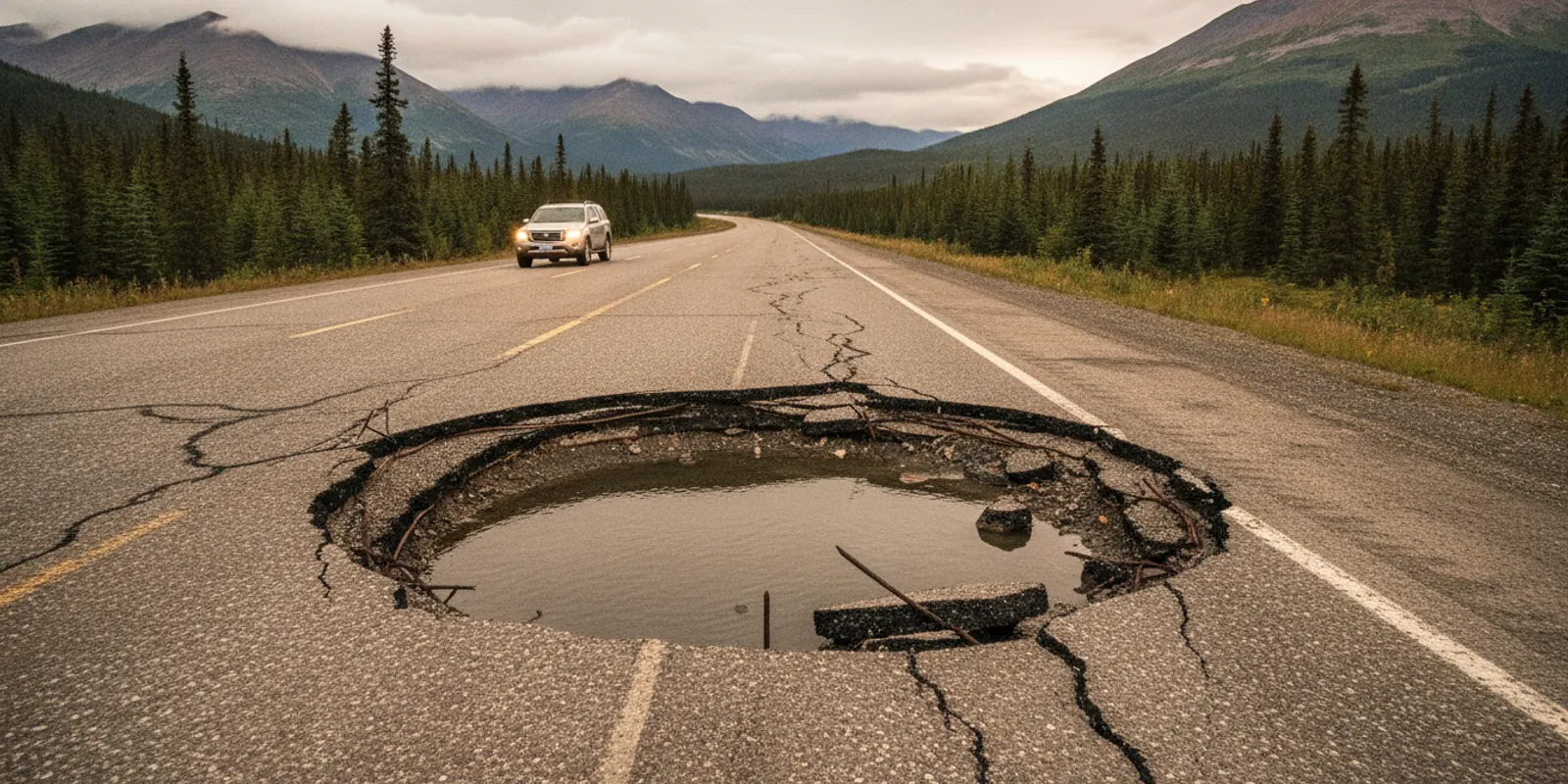
An alaska road defect accident claim may be possible when a dangerous roadway condition contributed to a crash and the evidence supports that another party was legally responsible. A pothole, missing sign, loose gravel, or damaged shoulder does not automatically prove liability. The key questions are what caused the crash, who was responsible for the roadway, whether that party knew or should have known about the hazard, and whether the defect caused a compensable injury.
Request a free consultation to discuss your situation. The Law Office of Jason Skala, LLC handles serious injury cases on a contingency-fee basis, so clients pay no upfront attorney fees and fees are owed only if there is a successful recovery.
Can a road defect lead to an injury claim in Alaska?
It can, depending on the facts. A roadway condition may play a part in a crash, but a claim generally requires more than showing that pavement was uneven or a sign was hard to see. The investigation must connect a specific hazard to the collision and identify a person, business, or public entity that had a legal responsibility related to that hazard.
Examples of possible roadway hazards include a large pothole, an eroded shoulder, an unmarked drop-off, debris or gravel left in a travel lane, a missing or obscured warning sign, or a work zone that gives drivers too little warning. Whether any particular condition is unreasonably dangerous depends on its size, location, visibility, duration, surrounding traffic conditions, and other facts. Alaska weather and road conditions can be part of that context, but weather alone does not answer who is responsible.
There may also be more than one contributing cause. A driver’s speed, visibility, distraction, vehicle condition, or response to a hazard may be examined alongside road maintenance and warning practices. A driver should not assume that a defect proves a claim, or that a possible driving mistake automatically bars one. Responsibility and the effect of each factor depend on the evidence and applicable law.
Who may be responsible for a road hazard?
First identify who owned, controlled, maintained, or was performing work on the roadway at the relevant place and time. Depending on the location and circumstances, that might involve a state or local public entity, a private property owner, a construction or maintenance contractor, or another party. The road’s appearance alone may not reveal who was responsible. A route can cross different jurisdictions, and construction activity may involve a separate contractor.
Useful starting points include the precise crash location, road name and direction of travel, nearby intersections or mile markers, and any visible work-zone signs. Police or incident records may help identify agencies that responded, but they may not settle ownership or maintenance responsibility. The responsible party may need to be identified through records or investigation.
For a broader overview of injury issues after a vehicle crash, see the firm’s car accident information. A road-defect issue can overlap with a regular collision claim, but it adds questions about control, maintenance, warnings, and notice of the hazard.
What proof matters in a road-defect claim?
Evidence needs to explain both the roadway condition and the crash. The strongest records are often made close in time to the event, before weather, traffic, repairs, or routine maintenance change the scene. If you are injured, prioritize medical care and personal safety. Do not enter traffic or return to a dangerous location to take photographs.
- Scene photographs and video: If it is safe, photograph the defect from several angles and distances. Include a wider view that shows the lane, nearby signs, lighting, and the road layout. A familiar object may help show scale, but do not put yourself or anyone else at risk to create a comparison.
- Location details: Record the route, direction of travel, nearest cross street, milepost, GPS location if available, and the lane or shoulder involved. A clear location can help determine which party maintained the roadway.
- Crash and vehicle records: Keep photographs of vehicle damage, repair estimates, towing records, and any incident or police report. Preserve dash-camera footage promptly because some systems overwrite recordings.
- Witness information: If someone saw the roadway or collision, note their name and contact details if appropriate. Ask them to keep any photos or video they already have; do not coach them on what to say.
- Medical and work records: Keep appointment information, discharge instructions, bills, and records of missed work or changed duties. These records can help document the injury and its effect, not just the condition of the road.
- Prior hazard reports: Complaints, work orders, inspection logs, repair records, and maintenance schedules may help establish when a hazard arose and whether the responsible party had information about it. These materials are not always available to an injured person without a formal request or legal process.
Write down what you remember as soon as you can, including weather, lighting, traffic, approximate speed, warnings, and how the vehicle responded. Keep the original files when possible. Avoid editing the only copy of a photograph or posting a detailed account online while facts are still being gathered.
Why do notice and timing matter?
Notice is a central issue in many roadway cases. Investigators may ask when the defect first appeared, whether it was reported, whether the responsible party inspected the area, and how much time passed before the crash. A party may dispute responsibility if it did not know of the hazard and the available evidence does not show that it should have discovered it in time to act. Conversely, prior complaints, inspection records, or visible deterioration may be relevant to what the responsible party knew or should have known. The answer depends on the evidence and the legal duties that apply to that party.
Do not assume that a hazard was reported just because it was visible, or that no record exists because you cannot find one yourself. The absence of a report in one place does not settle what an agency, contractor, or property owner knew. A careful inquiry may involve records requests, maintenance information, work-zone documents, or witness accounts.
Timing also matters because evidence can disappear. A pothole may be filled, a temporary sign moved, a work zone changed, or video footage overwritten. A driver’s own photographs and notes can be useful, but they do not replace a prompt investigation where the injury is serious or the site may change.
What changes if a public entity may be involved?
A claim involving a public road can raise issues that do not arise in the same way in a claim against a private party. Rules about public-entity responsibility, immunity, notice, and filing deadlines can be different and may depend on the facts and the particular entity. Do not assume that the ordinary process or deadline for a private insurance claim applies. A claim notice or lawsuit deadline may arrive sooner than expected, and sending a general complaint about a road condition may not satisfy a legal notice requirement.
Because these rules are fact-specific, get advice from an Alaska attorney promptly if a government agency may have responsibility. Preserve the location details and records you have, and ask what steps are required to protect a potential claim. This article is general information, not a legal opinion about a particular road or crash.
For current crash reporting instructions and forms, consult the Alaska Department of Transportation crash reporting page. Reporting requirements and the appropriate form depend on the circumstances, so review the agency’s current instructions. A crash report can document important details, but it does not by itself decide who is legally responsible for a roadway defect.
How can a driver distinguish a road defect from a driving issue?
The question is not always either-or. A road condition and a driver’s conduct can both contribute to a collision. For example, a driver may encounter a damaged shoulder at night, while the investigation also considers speed, lighting, warning signs, and how long the condition existed. Another driver may have had little opportunity to avoid a sudden hazard. Each situation calls for evidence about what a reasonably careful person could see and do under the circumstances, along with evidence about maintenance and notice.
Be precise when describing what happened. Instead of concluding that “the road caused everything,” preserve what you observed: where the defect was, whether it was visible, what warning signs were present, the path the vehicle took, and what happened next. A neutral, detailed account is more useful than a guess about fault.
When a collision involves another vehicle as well as a road condition, insurance questions can also arise. The firm’s overview of its personal injury practice explains its focus on serious injury matters. It is sensible to avoid treating an early insurance position as the final answer about what caused a crash or which parties may be involved.
What should you do after a crash involving a road hazard?
- Get to safety and seek medical care. Call for emergency help when needed. Do not delay care to collect evidence or argue about responsibility.
- Report the crash when required. Follow current instructions from law enforcement and the appropriate state agency. Alaska DOT provides driver crash reporting forms and information; check its current page for details relevant to your circumstances.
- Record the location and scene if it is safe. Take wide and close photographs, note road and weather conditions, and identify the direction of travel and nearby landmarks.
- Keep evidence together. Save photos, video, correspondence, medical information, and repair documents. Make a backup of dash-camera footage before it is overwritten.
- Use care when speaking with insurers. Provide accurate basic information, but do not guess about a technical cause or sign a release before understanding what it covers. Keep copies of communications.
- Ask promptly about legal time limits. This is especially important if a public entity, road contractor, or serious injury is involved. Identifying a responsible party and preserving evidence can take time.
Crash reporting is one part of documenting an event, not a substitute for a separate inquiry into the road condition. The Alaska reporting resource describes when a driver involved in certain crashes must submit a report and provides forms; consult its current guidance rather than relying on an informal summary. Keep proof of any submission or communication you make.
How do possible claim paths compare?
The route of a potential claim depends on who controlled the location and what evidence links that party to the hazard. The table is a starting point, not a decision about liability in a particular case.
| Possible source of the hazard | Questions to investigate | Records that may help | Important caution |
|---|---|---|---|
| Public road or shoulder | Which entity had responsibility? Was the condition known or discoverable? Do special notice or immunity rules apply? | Crash location, photographs, agency records, maintenance and inspection information, prior complaints | Public-entity rules and deadlines can differ; seek Alaska-specific advice promptly. |
| Private road or property access | Who owned or controlled the area? Was the hazard foreseeable and were warnings or repairs appropriate? | Property or access location, scene photos, witness information, maintenance records | Responsibility depends on control and the facts, not only who owns nearby land. |
| Construction or maintenance work | Who performed the work? Were signs, barriers, or traffic controls present and maintained? | Work-zone photos, contractor or project details, signs, incident records, available work documents | More than one party may be involved; the responsible parties may not be obvious at the scene. |
| Road condition plus driver conduct | How did visibility, speed, warning, vehicle movement, and driver response combine? | Video, vehicle damage, witness accounts, scene measurements, medical records | A driver’s conduct and a roadway hazard may both be examined. |
What can an attorney help investigate?
In a serious injury case, legal help may include identifying potential responsible parties, preserving relevant evidence, assessing what records are needed, and evaluating how the road condition relates to the injury. That can require more than reviewing a police report. A report may record observations made soon after the crash, but it may not determine who maintained the road, what that party knew, or whether a warning was adequate.
An attorney can also help organize the injury evidence and communicate with insurers while the investigation proceeds. The Law Office of Jason Skala, LLC focuses exclusively on serious personal injury and wrongful death matters. Attorney Jason Skala has more than 20 years of experience limited to personal injury and a family background in medicine that informs his ability to read medical records. Learn more about Jason Skala and his practice.
A consultation does not mean every crash will result in a claim or recovery. The relevant question is whether the available facts support legal responsibility and damages under the law that applies. The firm offers free initial consultations and handles cases on a contingency-fee basis: clients pay no upfront attorney fees, and the fee is collected only after a successful recovery.
Schedule a free consultation to discuss the road condition, your injuries, and what evidence may need to be preserved. There are no upfront attorney fees under the firm’s contingency-fee arrangement.
Frequently asked questions
Does a pothole automatically make the road owner liable?
No. A pothole may be relevant evidence, but a claim also turns on issues such as who controlled the road, how the condition contributed to the crash, what the responsible party knew or should have known, and whether the injury and damages can be documented. The size, visibility, and location of the pothole may matter.
What if I did not photograph the road at the scene?
You can still preserve other evidence. Write down the location and what you remember, save vehicle and dash-camera images, keep the crash report and medical records, and identify witnesses if possible. The roadway may have changed, so seek advice promptly about whether other records or evidence can help reconstruct the condition.
Can I make a claim if another driver was also involved?
Possibly. A collision can involve several contributing factors, including another driver’s actions and the road condition. The facts should be investigated before assuming that one cause excludes the other. Insurance and liability questions may depend on how each factor contributed.
Should I contact an agency about the defect?
Reporting a hazard may help alert the responsible agency, but a general report is not necessarily the same as formal legal notice of a claim. Follow the relevant agency’s current instructions, keep a copy of what you submit, and ask an Alaska attorney promptly about any separate notice or filing requirements if you were injured.
What is the key takeaway?
An alaska road defect accident claim depends on proof that a specific roadway condition contributed to an injury and that an identifiable party may be legally responsible. Document the scene safely, preserve records, identify who controlled the road, and get timely advice when a public entity or serious injury may be involved. The Law Office of Jason Skala, LLC offers free consultations and represents serious injury clients on a contingency-fee basis, so there are no upfront attorney fees.